
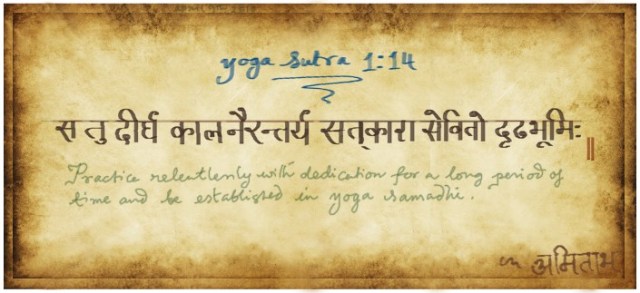
The Yoga Sutra, the preeminent text on yoga consists of four padas—or sections—each containing a number of individual sutras. In his Yoga Sutra, the sage Patanjali sheds light onto the workings of the human mind, the specific and particular brands of suffering that we unwittingly impose upon ourselves, and the full picture of healing and resolution for our suffering. Patanjali has offered a codification and thorough description of the practice of yoga, and the means for relieving the inevitable suffering of the human mind that is not aware of its inherent depth of intelligence and power—Pure Unmanifest Awareness. Patanjali provides us with a precise outline for practice.
I. Samadhi Pada defines yoga and puts the practice in perspective. We are introduced to the ways that our individual minds cloud our experience of the true nature of life.
II. Sadhana Pada covers the yamas, niyamas, asana, and pranayama. It provides the necessary framework for effective practice. Pranayama is the gateway to the inner world.
III. Vibhuti Pada takes over where Sadhana Pads leaves off, honing in on the more subtle aspects of practice. Beginning with pratyahara, it addresses the ways to continue to refine our awareness, addressing, dharana, dhyana, samadhi. This pada moves into the realm of samyama—the integration of the three.
IV. Kaivalya Pada: In the final Pada, Patanjali brings together many of the more esoteric and sometimes difficult to understand teachings of the practicality of practice. Although it may read as densely philosophical, it is rich with subtle practices of inquiry. Patanjali invites us in even deeper. When awareness has been mostly cleared these inquiries can bear fruitful knowledge and the inquiry itself continues to refine and hone the individual consciousness—making it a more and more radiant and open receptacle of Divine Light.
At the beginning of the Yoga Sutra, Patanjali lays out the context for practice. He encapsulates his entire message in the first three sutras, immediately addressing the need for practice, what the process requires, and the goal. If the first three sutras are intriguing enough, one will practice. If they are not, there will be little motivation to continue.
Sutra 1:1
atha yoganuśhāsanam
Now begins the instruction on the practice of yoga.
Atha communicates the auspicious nature of the teachings that are about to be elucidated. Most commonly translated as “now”, atha is also the expression of the self-luminous guiding Intelligence that resides within the heart and mind of every human being. By using the term atah to initiate his treatise on yoga, Patanjali sets the stage for the comprehensive message that will follow: we are all radiant beings, our very nature is manifesting into form with brilliance and power, and it is possible to recognize this directly. The meaning of “now” is in itself auspicious. Now is the present moment, the place of no future, no past, only this exact unmoving place of presence and radiance. Now describes the unified state of mind. In the first sutra, Patanjali has created an inclusive container for all the teachings that are to come.
He continues to say that “now”, perhaps you may be open to undertaking the inquiry that will reveal the core of being to your conscious awareness. The implication is that now one may actually be ready to practice yoga. One has tried everything else, and finally understands the futility of looking for satisfaction within the arena of the solely personal field of individual mind. Having seen and tried every machination of effort to gain contentment in a life perceived through the most superficial layers of consciousness, one is now ready to seriously embark on the study of yoga.
With the term anuśhāsanam, Patanjali is stating emphatically that yoga means practice. Patanjali lets us know right away that the Yoga Sutra is not simply a philosophical text. Patanjali is stating right at the start that yoga requires practice and the strong implication is that practice will require commitment and fortitude. Continue reading
 Embodyoga®